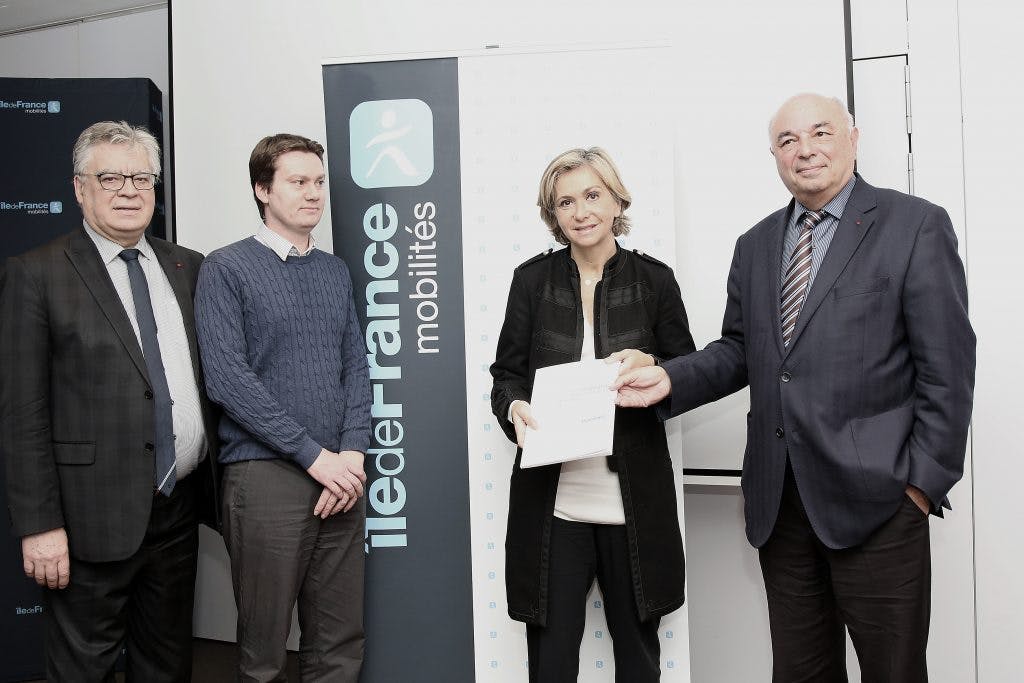
Members of the committee for the evaluation of the transport offer in Île-de-France:
- Jean-Paul Bailly, former Chairman and Chief Executive Officer of RATP and former Chairman of the La Poste Group, who chairs the committee
- Yves Ramette, former Managing Director of SNCF Réseau Île-de-France and former Deputy Managing Director of RATP
- Yves Crozet, professor at the University of Lyon and former director of the Laboratory of Planning, Economics and Transport (LAET)
- Marc Pélissier, president of the Association of Transport Users FNAUT Île-de-France.
Transparency, impact assessment, lessons, the explanations of the desired approach of the work in a few words by the members of the committee:
The culture of evaluation is not very developed in France. And, in fact, it is indeed an unprecedented evaluation exercise that the President of the Île-de-France Region has invited us to carry out: to measure, year after year, the impact of the various and very varied new features of the year in the field of public transport.
In order to carry out this rather innovative exercise, it seemed important to us not to limit ourselves to a global approach using general statistics that are often fairly well known, but not very homogeneous and necessarily vary significantly from one year to the next. In addition, it seemed essential to us to have a specific approach, operation by operation, trying to bring together all the relevant data, limiting ourselves to the facts without passing judgment.
The reader will find, in complete transparency, a mine of information that is often little known to better appreciate the impact and relevance of the various operations. These documents still contain a number of imperfections or shortcomings that we will try to remedy year after year. Due to its diversity and multifaceted nature, this document makes it possible to understand the difficulties of the exercise.
- The first is the time between the first approval and commissioning, which often exceeds ten years, even for modest operations. The commissioning itself is spread over several years. These are deadlines that far exceed the political deadlines.
- The second is the result of the diversity, heterogeneity and simultaneity, normal and even desirable, of operations: new infrastructure, network restructuring, new operating schedules, modernisation of stations, intermodality, renewal of rolling stock, pricing decisions, etc. The impacts themselves are very diverse: number of passengers concerned, time, comfort and safety savings, modal shifts, impacts on noise and pollution, economic gains, etc. Any aggregation is impossible, the overall assessment is difficult.
Cause-and-effect links are multifaceted and therefore difficult to establish. It is practically impossible, if we want to remain objective and stick to the facts, to directly link cause and effect as the factors, including those external to an operation, are so multiple and interdependent. In particular, modal shifts, one of the main objectives of the policy for the development and improvement of public transport, are difficult to measure, particularly in the short term, because of the very gradual ramp-up, the slow pace of change in habits and the evolution of urbanisation. As a result, they often appear modest and disappointing.